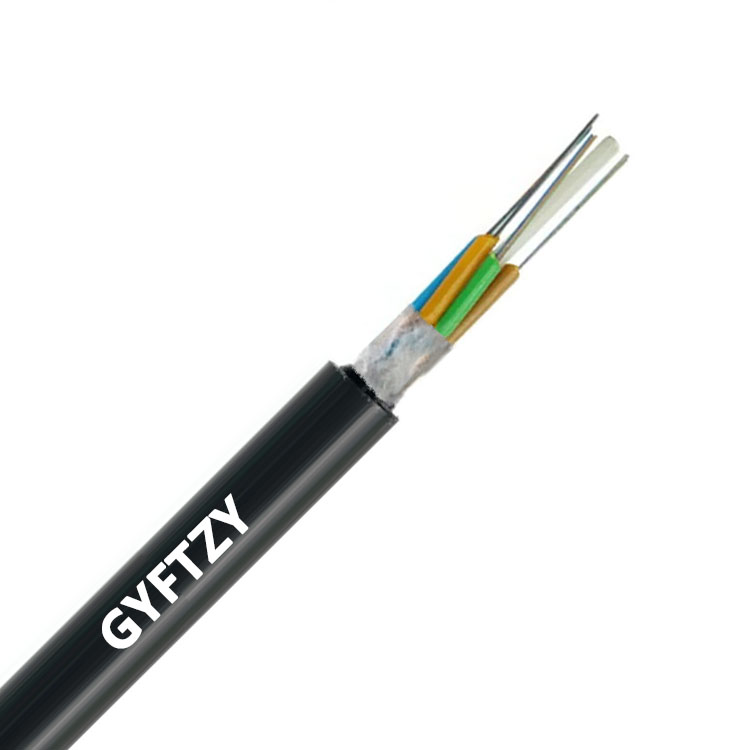
Non-metallic stranded loose tube outdoor fiber optic cable for duct, tunnel, building entry, and routes requiring flame-retardant sheath performance. Confirm the sheath material, applicable standard, and documentation in the project specification.
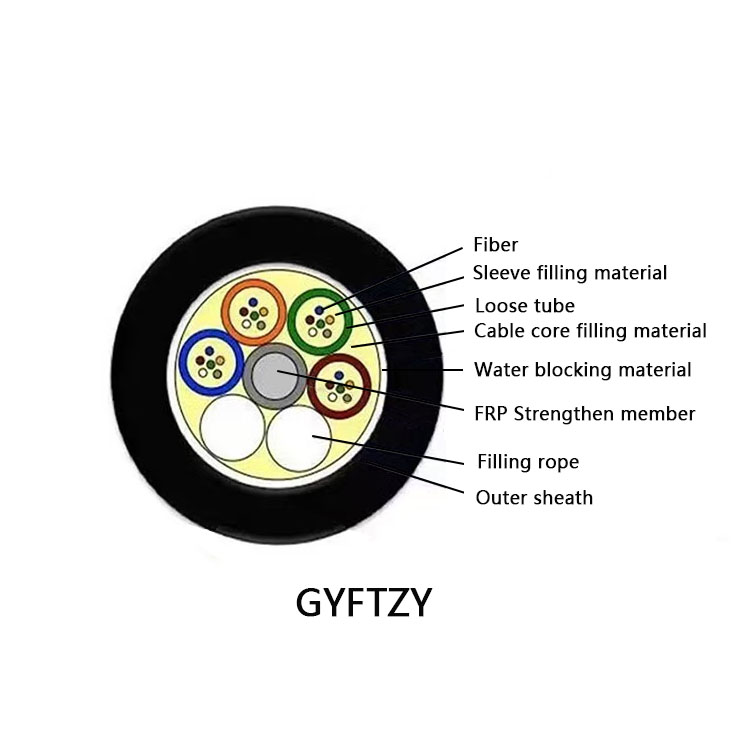
GYFTZY is an outdoor stranded loose tube fiber optic cable designed for routes requiring a non-metallic central strength member and an LSZH flame-retardant outer sheath. Based on the GYFTY stranded loose tube design, GYFTZY replaces the standard PE outer sheath with an LSZH flame-retardant outer sheath. Fiber type, fiber count, tube layout, and mechanical performance must be confirmed against the final cable design and project requirements.
Request Quote Download DatasheetGYFTZY fiber optic cable is a non-metallic flame-retardant stranded loose tube outdoor fiber cable. It is used for duct, tunnel, campus, access, and power-adjacent communication routes where non-metallic construction and an LSZH flame-retardant sheath are required.
Compare GYFTZY with similar cable types for your project.
| Requirement | GYFTZY (LSZH) | GYFTY (PE Sheath) | GYFTA (Alu Tape) |
|---|---|---|---|
| Sheath material | LSZH flame-retardant | PE | PE |
| Flame-retardant requirement | Confirm standard and test method | Not the standard selection | Not the standard selection |
| Smoke and halogen requirement | Confirm project requirement | Standard PE | Standard PE |
| Electrical consideration | Non-metallic construction | Non-metallic construction | Metallic tape construction |
| Best Pick | LSZH-required routes | General outdoor routes | Routes needing APL moisture barrier |
| Product model | GYFTZY |
|---|---|
| Cable structure | Non-metallic stranded loose tube fiber optic cable |
| Strength member | FRP or equivalent non-metallic central strength member |
| Water blocking | Water-blocking material and filling compound according to final design |
| Outer sheath | Flame-retardant PE or LSZH jacket option, depending on project requirements |
| Typical application | Duct, tunnel, campus, access, and outdoor distribution networks |
| Fiber Type | Typical Attenuation at 1310 nm | Typical Attenuation at 1550 nm | Notes |
|---|---|---|---|
| G.652.D | ≤ 0.36 dB/km | ≤ 0.22 dB/km | Common single-mode fiber for outdoor networks. |
| G.657.A1 / A2 | ≤ 0.36 dB/km | ≤ 0.22 dB/km | Bend-insensitive options available by request. |
Values are typical references. Final optical parameters should be confirmed by datasheet, fiber brand, and project specification.
Underground tunnels, cable ducts, and shared infrastructure routes where flame-retardant cable is specified.
Indoor-outdoor transition at building entry points where flame-retardant sheath material is required for compliance with local building codes.
Substations, power plants, railway corridors, and industrial zones where a non-metallic cable design is specified.
Oil & gas, mining, chemical plants, and other industrial facilities requiring flame-retardant and non-metallic cable specifications.
Feeder cables from splitter cabinet to building entry in FTTH networks where flame-retardant sheath is required for indoor transition.
Use this comparison to decide whether GYFTZY or another outdoor cable structure better fits the route requirements.
Non-metallic flame-retardant stranded loose tube cable.
Non-metallic stranded loose tube outdoor cable without flame-retardant emphasis.
Stranded loose tube cable with aluminum tape moisture barrier.
Stranded loose tube cable with steel tape protection.
Configure the key requirement for GYFTZY Non-Metallic Flame-Retardant Stranded Loose Tube Fiber Optic Cable. Select standard options or enter custom notes, then send your RFQ by WhatsApp or email.
Non-metallic loose tube outdoor cable for aerial and duct use.
APL moisture barrier stranded loose tube outdoor cable.
Steel tape armored stranded loose tube outdoor cable.
All-dielectric self-supporting aerial fiber optic cable.
Central tube figure-8 aerial fiber optic cable.
Non-metallic stranded loose tube outdoor fiber cable.