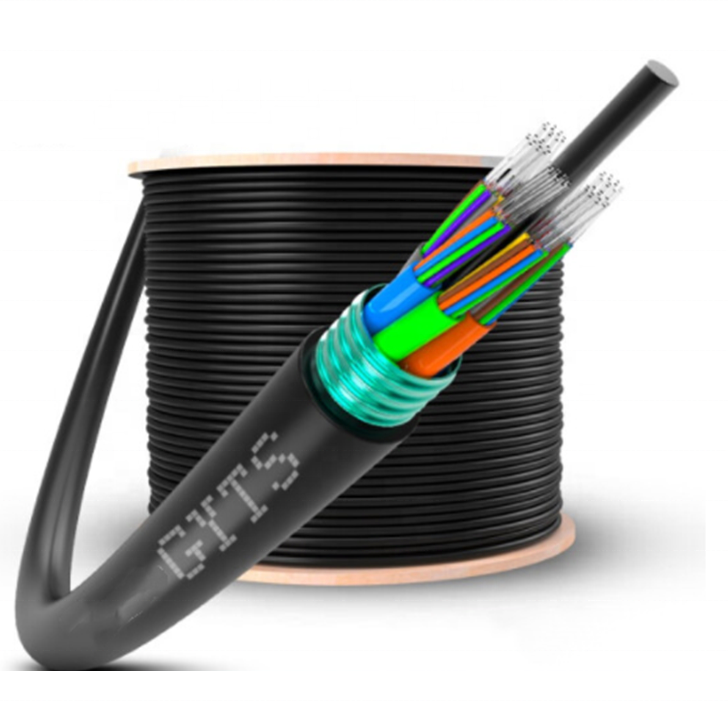
Stranded loose tube outdoor cable with Corrugated steel tape / PSP armor for duct, campus backbone, and metro access networks.
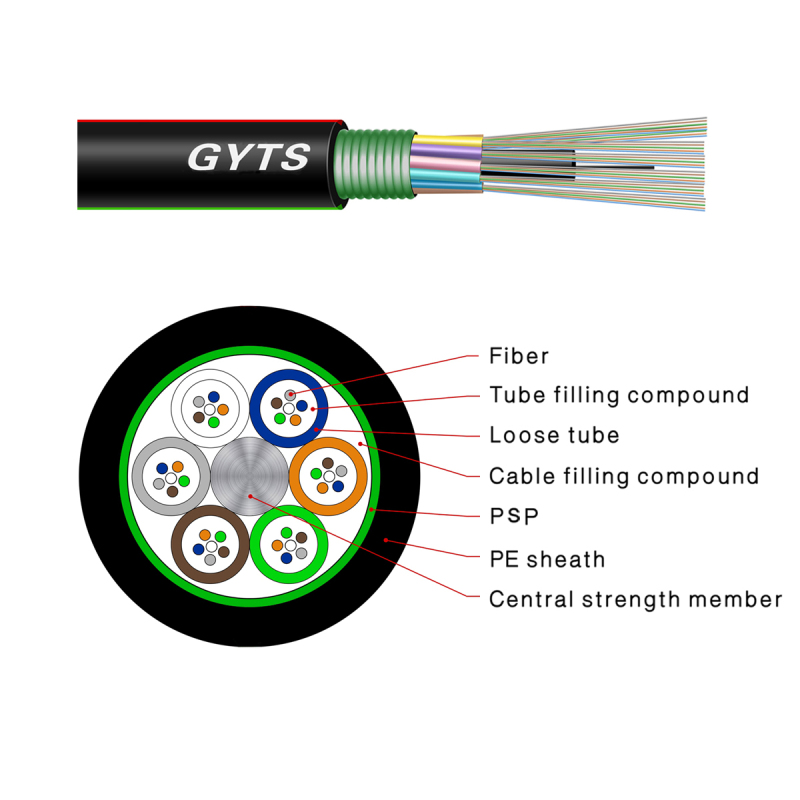
GYTS is an outdoor stranded loose tube steel tape armored fiber optic cable designed for duct, backbone, and outdoor distribution applications. Optical fibers are placed inside water-blocking filled loose tubes stranded around a metallic central strength member. The corrugated steel tape / PSP armor and PE outer sheath provide enhanced mechanical protection and outdoor environmental performance, while final cable parameters remain subject to project requirements and confirmed cable design.
Request Quote Download DatasheetGYTS is a stranded loose tube outdoor fiber optic cable with corrugated steel tape or PSP (steel-plastic laminated) armor for enhanced mechanical protection. It is designed for duct, backbone, campus, and metro access network installations where crush, impact, and rodent resistance matter. GYTS is not suitable for aerial self-supporting installations (use ADSS or Figure-8 instead) or direct burial with double-armor requirements (consider GYTA53 or GYTY53 instead).
Choose the right stranded loose tube cable based on your installation environment:
| Scenario | Recommended Cable | Key Protection | Best Pick |
|---|---|---|---|
| Standard duct / conduit backbone | GYTS | Steel tape/PSP armor | GYTS |
| Moisture barrier needed, low rodent risk | GYTA | APL moisture barrier | GYTA |
| Direct burial / high rodent risk | GYTA53 / GYTY53 | Double sheath + steel tape armor | GYTA53 |
| Central tube, lower fiber count | GYXTW | Steel tape + parallel steel wires | GYXTW |
| Non-metallic, EMP-sensitive | GYFTY / GYFTA | All-dielectric, FRP strength members | GYFTY |
Confirmed specifications for GYTS Stranded Loose Tube Outdoor Fiber Optic Cable
| Layer | Component | Material / Function |
|---|---|---|
| 1 | Optical Fiber | G.652D / G.657A1, multiple fibers per loose tube, subject to project requirements |
| 2 | Loose Tube | PBT (polybutylene terephthalate) loose tube, gel-filled for buffer and water-blocking |
| 3 | Tube Filling | Thixotropic filling compound for longitudinal water-blocking |
| 4 | Central Strength Member | Steel wire (metallic CSM), supporting cable tensile strength |
| 5 | Cable Core | Water-blocking elements (tape or filling compound, project-dependent) |
| 6 | Tape Armor | Corrugated steel tape / PSP armor, radial compressive protection |
| 7 | Outer Sheath | PE (polyethylene), black, outdoor UV-resistant |
Typical values for reference. Final parameters depend on fiber count, sheath, armor, cable structure, and customer specification.
Typical values for reference. Final cable parameters depend on fiber count, sheath, armor layer, cable structure, and customer specification.
| Parameter | Typical Value |
|---|---|
| Attenuation @ 1310 nm | ≤ 0.35 dB/km (typical) |
| Attenuation @ 1550 nm | ≤ 0.22 dB/km (typical) |
| Operating Temperature | Typical range, subject to final cable design and project requirements |
| Storage Temperature | Typical range, subject to final cable design and project requirements |
| Standards | Applicable standards and compliance requirements should be confirmed according to project specifications |
| Compliance Documentation | Available upon request |
Typical values for reference. Final parameters depend on fiber count, sheath, armor, cable structure, and customer specification.
Outdoor duct and conduit installations in telecom, utility, and municipal networks.
Inter-building duct connections in university, industrial park, and business park campuses.
Metropolitan access and feeder networks connecting central offices and distribution points.
Backbone and distribution cable for telecommunications carrier and ISP network infrastructure.
Custom outdoor routing for rail, utility tunnel, industrial compound, and security network projects.
See the detailed GYXTW vs GYTS comparison for stranded loose tube versus central loose tube selection, fiber count planning, installation environment, and cost factors. Compare GYTS with GYXTW.
GYTS compared with GYXTW (central loose tube) and GYTA (APL moisture barrier) — three common outdoor stranded/central loose tube cables.
| Aspect | GYTS | GYXTW |
|---|---|---|
| Cable Core | Stranded loose tube | Central loose tube |
| Fiber Count | Common 4–144 cores; higher counts require technical confirmation | Common 2–12 cores (single tube) |
| Armor | Corrugated steel tape / PSP | Steel tape moisture barrier |
| Strength Member | Steel wire (central) | Parallel steel wires (two sides) |
| Best For | Higher fiber count backbone | Lower fiber count distribution |
| Crush Resistance | Higher (steel tape armor) | Moderate (steel tape + wires) |
| Aspect | GYTS | GYTA |
|---|---|---|
| Metallic Protection | Corrugated steel tape / PSP armor | APL (aluminum-polyethylene laminate) |
| Primary Purpose | Crush/rodent mechanical protection | Moisture barrier |
| Weight | Heavier (steel armor) | Lighter (aluminum laminate) |
| Crush Resistance | Higher | Moderate |
| Rodent Protection | Better (steel armor) | Limited (thin aluminum) |
| Cost | Higher (steel armor material) | Lower (APL material) |
| If You Need... | Choose |
|---|---|
| Steel armor for backbone duct with crush risk | GYTS |
| Lower cost, good moisture barrier for standard duct | GYTA |
| Central tube, low fiber count (2-12 cores) | GYXTW |
| Direct burial with double armor | GYTA53 / GYTY53 |
| All-dielectric, no metallic components | GYFTY / GYFTA |
Configure the key requirement for GYTS Stranded Loose Tube Outdoor Fiber Optic Cable. Select standard options or enter custom notes, then send your RFQ by WhatsApp or email.
APL moisture barrier stranded loose tube outdoor cable.
Central loose tube outdoor fiber optic cable.
53-type armored outdoor cable for harsh installation environments.
Double-sheath armored outdoor fiber optic cable.
Armored outdoor cable for direct burial applications.
Central tube outdoor fiber optic cable with PE sheath.
Need to decide between central loose tube and stranded loose tube construction? Read the GYXTW vs GYTS comparison and the GYXTW specification guide. Need to decide whether the additional inner sheath and direct-burial protection of GYTS53 are required? Read the GYTS vs GYTS53 engineering comparison.
Use the procurement checklist to define fiber performance, cable construction, mechanical tests, drum requirements, documentation, inspection, and acceptance criteria.
Read the technical guide →Compare stranded loose tube cable construction and route requirements before confirming a specification.