Get Quote
HomeAboutProductsSolutionsPartnersInsightsContact Get Quote
Home/Products/Outdoor Cables/GYDTS53 Armored Double Sheath Ribbon Fiber Optic Cable

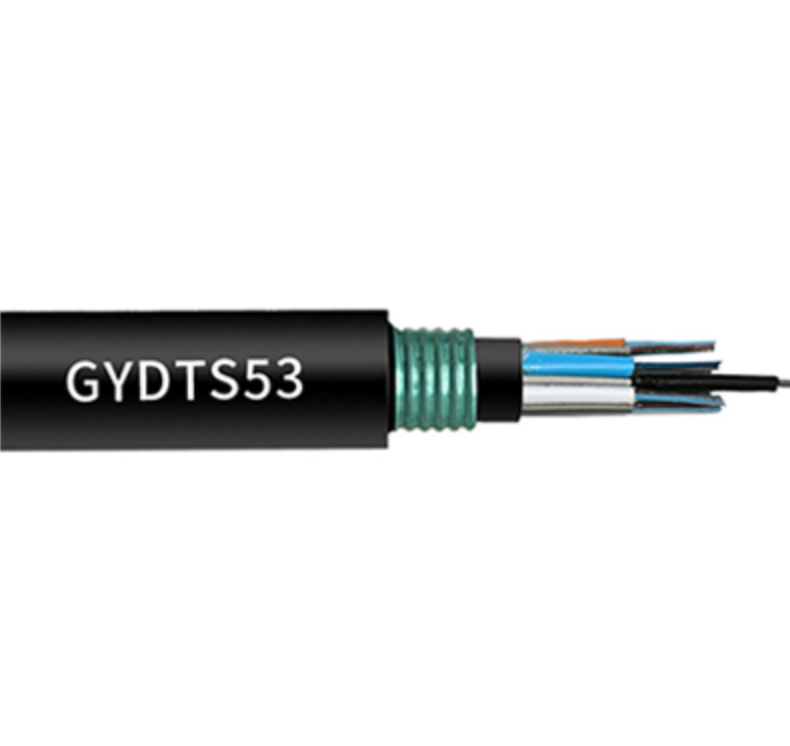
GYDTS53 Armored Double Sheath Stranded Loose Tube Ribbon Fiber Optic Cable

Armored stranded loose tube ribbon fiber optic cable with corrugated steel tape/PSP armor, metallic central strength member (steel wire), and double PE sheath for direct burial and harsh outdoor routes requiring both high fiber density and maximum mechanical protection.

Ribbon Fiber Armored PSP Steel Tape Double PE Sheath Metallic CSM
GYDTS53 Armored Ribbon Fiber Optic Cable
GYDTS53 structure diagram

Product Overview

GYDTS53 is an armored stranded loose tube ribbon fiber optic cable featuring an inner PE sheath, corrugated steel tape (PSP) armor, and an outer PE sheath. This multi-layer design delivers moisture resistance and enhanced mechanical protection for outdoor backbone and trunk routes when installed in suitable duct or project-confirmed direct-burial conditions. The ribbon fiber structure enables significantly higher fiber density compared to standard loose tube cables. Final fiber count, ribbon configuration, and cable dimensions depend on the project specification.

Request Quote Download Datasheet

Product Answer

What is GYDTS53 fiber optic cable?
GYDTS53 fiber optic cable is an armored stranded loose tube ribbon fiber optic cable with corrugated steel tape/PSP armor, a metallic central strength member (steel wire), and a double PE sheath. It is designed for direct burial, harsh outdoor environments, and high-density backbone projects requiring mass fusion splicing and maximum mechanical protection. MapleArashi manufactures GYDTS53 with up to 288 fibers, G.652D or G.657 fiber types, and customizable options.

Quick Selection Guide

Compare GYDTS53 with other armored outdoor fiber cables to select the right design for your project.

RequirementGYDTS53 (Ribbon, Steel Tape, Double PE)GYDTA53 (Ribbon, APL, Double PE)GYDTS (Ribbon, Steel Tape)GYDTA (Ribbon, APL)
Fiber typeRibbon (max 288F)Ribbon (max 288F)Ribbon (max 288F)Ribbon (max 288F)
Moisture barrierWater-blocking onlyAPL tapeWater-blocking onlyAPL tape
ArmorSteel tape (PSP)Steel tape (PSP)Corrugated steel tapeNone
SheathDouble PEDouble PESingle PESingle PE
Best forHarsh direct burialDirect burial with moistureDuct with rodent riskBackbone/metro duct
Best Pick★★★Harsh direct burialDirect burial with moistureDuct with rodent riskBackbone/metro duct

Key Takeaways

  • GYDTS53 combines ribbon fiber technology with 53 armor structure (steel tape + double PE sheath) for maximum protection in direct burial and harsh environments.
  • Ribbon fiber enables mass fusion splicing up to 12 fibers per splice, significantly reducing deployment time for high-density backbone projects.
  • Corrugated steel tape armor plus double PE sheath provides superior crush and rodent resistance for underground and direct burial installations.
  • Available with G.652D, G.657A1, or G.657A2 fiber types; up to 288 fibers in ribbon configurations.
  • Not suitable for all-dielectric or EMI-sensitive environments due to metal CSM and armor. For non-metallic alternatives, consider GYFTY53 or GYFTY53.

Citable Specification Notes

  • Operating temperature: -40C to +70C (per IEC 60794)
  • Bend radius: 20x cable diameter (static), 10x (dynamic per IEC 60794)
  • Fiber count: Up to 288 fibers in mass fusion-ready ribbon configuration
  • Crush resistance: Steel tape armor provides 2200 N/100mm per IEC 60794

Product Structure

GYDTS53 armored direct burial fiber optic cable structure

GYDTS53 is a double-sheath steel tape armored outdoor fiber optic cable designed for direct burial, duct, and heavy-duty outdoor backbone routes. The structure combines stranded loose tubes, water-blocking protection, metallic armoring, and PE sheath protection.

  • Stranded loose tube coreFibers are placed in loose tubes around a central strength member for stable multi-fiber outdoor cable construction.
  • Steel tape armorCorrugated steel tape improves crush resistance for direct burial and demanding outdoor routes.
  • Double sheath protectionInner and outer PE sheath layers improve moisture resistance and mechanical durability.
LayerComponentMaterial / Function
1Optical fiber unitFibers inside loose tubes according to project fiber count.
2Central strength memberProvides cable core stability and tensile support.
3Water blockingFilling compound and water-blocking materials protect the cable core.
4ArmorCorrugated steel tape improves crush and rodent protection.
5Outer sheathPE sheath protects the cable in direct burial and outdoor routes.

Key Features

  • Ribbon Fiber Technology
    Mass fusion splicing enables simultaneous splicing of 12 or 24 fibers, reducing installation time and splice cost in high-count backbone networks.
  • Double PE Sheath Protection
    Inner PE sheath and outer PE sheath provide dual-layer environmental protection, with corrugated steel tape / PSP armor sandwiched between them for enhanced mechanical, moisture, and rodent resistance.
  • High Fiber Density
    Ribbon fiber in stranded loose tube design maximizes fiber count per cable cross-section, ideal for space-constrained duct routes.
  • Fast Installation
    Ribbon fiber cable supports mass fusion splicing for faster backbone deployment compared to individual fiber splicing.
  • Future-Ready Capacity
    High fiber-count ribbon design provides room for network capacity expansion without additional cable installation.
  • Standards Compliance
    Compliance documentation available upon request for relevant standards.

Application Scenarios

Backbone Network

Long-haul and regional backbone routes where high fiber count and efficient splicing are required.

Metro Network

Metropolitan area network duct infrastructure for telecom operators requiring high fiber-density ribbon cables.

Access Network

Feeder and distribution segments in operator access networks where future capacity growth is expected.

Data Center Interconnect

High-count ribbon trunk cable between data center facilities in duct infrastructure.

FTTx Feeder

High-capacity feeder cable from central office or OLT to distribution cabinets in FTTH and FTTB networks.

Model Comparison: GYDTS53 vs Other Outdoor Fiber Cables

Compare GYDTS53 with related ribbon and armored outdoor cable designs before confirming project requirements.

GYDTS53

Structure: 53-type armored stranded loose tube ribbon fiber cable with enhanced external protection.

Typical Use: Direct-burial-oriented, harsh outdoor, and high-density backbone projects requiring stronger mechanical protection.

Selection Note: Choose GYDTS53 when ribbon fiber density and reinforced protection are both required; final design depends on project requirements.

GYDTS

Structure: Stranded loose tube ribbon fiber cable with steel tape / PSP armor and single-sheath design.

Typical Use: Outdoor duct backbone, metro, and trunk routes requiring ribbon fiber and steel tape protection.

Selection Note: Use GYDTS when steel tape protection is needed but a 53-type reinforced design is not required.

GYDTA53

Structure: 53-type armored ribbon cable design with APL moisture-barrier-oriented protection.

Typical Use: Outdoor routes requiring reinforced protection and project-specific moisture barrier requirements.

Selection Note: Confirm sheath, armor, and moisture-barrier requirements according to the project specification.

GYTA53

Structure: 53-type armored stranded loose tube outdoor cable.

Typical Use: Reinforced outdoor trunk or direct-burial-oriented routes where standard loose tube design is required.

Selection Note: Choose GYTA53 when 53-type protection is needed but ribbon fiber design is not required.

Why Choose MapleArashi for GYDTS53 Fiber Optic Cable?

Project-Based Supply Support

GYDTS53 cables are supplied through qualified production resources in China, with project-based quotation support and coordinated order fulfillment.

International Project Support

Fiber optic cable supply support for telecom operators, contractors, distributors, and project buyers in international markets.

Custom OEM/ODM Solutions

Flexible customization: fiber count, ribbon configuration, fiber type, armor, sheath, drum length, packaging. OEM/ODM branding available.

Quality Control System

In-house tensile, bend, crush, water-blocking, and dimensional testing per IEC 60794 standards. Compliance documents available upon request.

Global Logistics Network

Standard FCL and LCL shipping from Shenzhen port. DDP and express logistics available for samples and small orders.

Dedicated Sales Support

One-on-one engineering support for product selection. Sample approval before mass production.

GYDTS53 Cable Configurator

Configure the key requirement for GYDTS53 Armored Double Sheath Stranded Loose Tube Ribbon Fiber Optic Cable. Select standard options or enter custom notes, then send your RFQ by WhatsApp or email.

FAQ About GYDTS53 Armored Double Sheath Ribbon Fiber Optic Cable

Q1: What is the difference between GYDTS53 and GYDTS?
GYDTS53 uses a ribbon fiber structure with inner PE sheath and steel tape (PSP) armor between inner and outer PE sheaths. GYDTS uses ribbon fiber structure with corrugated steel tape armor and a single PE outer sheath. GYDTS53 offers higher fiber density through ribbon technology and provides double-layer mechanical protection. GYDTS offers standard armoring for loose tube fiber designs. The choice depends on fiber count requirements and installation conditions.
Q2: Is GYDTS53 suitable for direct burial?
GYDTS53 can be used for direct-buried outdoor routes when final cable design and project specification confirm the required armor, sheath, tensile, crush, and environmental parameters. The steel tape (PSP) armor between inner and outer PE sheaths provides enhanced crush resistance and rodent protection. For lighter duct-installation only applications, non-armored ribbon cable GYDTA may be considered depending on project specifications.
Q3: What is the advantage of ribbon fiber in GYDTS53?
Ribbon fiber allows mass fusion splicing, where 12 or 24 fibers can be spliced simultaneously. This significantly reduces installation time, splice cost, and cabinet space compared to individual fiber splicing in high-count backbone networks. Ribbon structure also enables higher fiber density per cable diameter.
Q4: What fiber counts does GYDTS53 support?
Fiber count depends on ribbon count, tube layout, and project specification. Please confirm the required fiber count and ribbon configuration before production.
Q5: Can I get custom drum lengths?
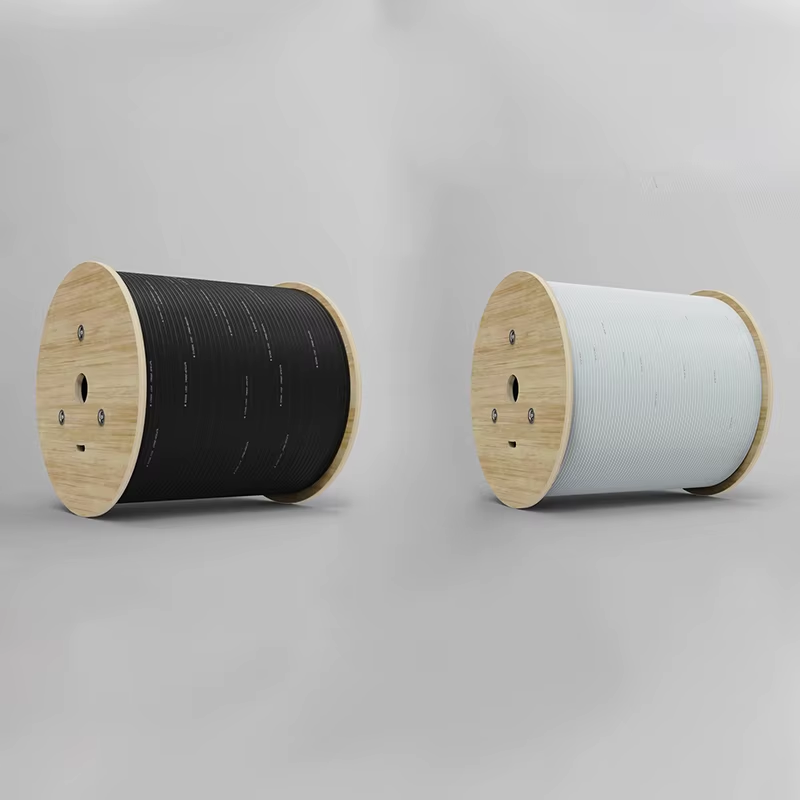
Drum length, packaging, sheath marking, and labeling can be customized according to project requirements.
Q6: What installation methods are suitable for GYDTS53?
GYDTS53 is suitable for direct burial outdoor backbone and trunk routes, duct installation requiring enhanced mechanical protection, metropolitan area network (MAN) feeder cables, high fiber-count interconnect links, and high rodent-pressure outdoor environments. It is not designed for self-supporting aerial installation (consider ADSS or Figure-8 cable options). Please confirm the installation method and environment with the project specification.