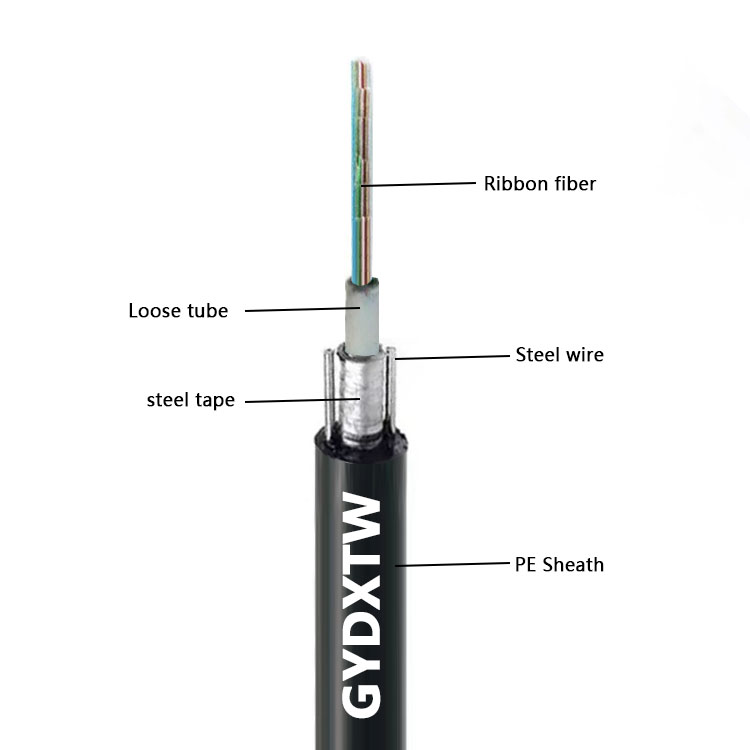
Compact ribbon fiber cable for high-density outdoor duct and distribution applications with mass fusion splicing.
GYDXTW is a central loose tube ribbon fiber optic cable designed for high-density outdoor duct and distribution applications. Optical fiber ribbons (up to 288 fibers) are placed inside a water-blocking filled central loose tube, enabling mass fusion splicing and efficient fiber management in a compact cable diameter. The PE outer sheath provides mechanical and environmental protection for underground duct installation. Fiber count, ribbon configuration, and mechanical design should be confirmed according to final cable specification and project requirements.
Request Quote Download DatasheetProduct Answer
What is GYDXTW fiber optic cable?
GYDXTW is a central loose tube ribbon fiber optic cable designed for high-density outdoor duct and distribution networks. It uses optical fiber ribbons (48–288 fibers) stacked inside a single central loose tube, enabling 12-fiber mass fusion splicing that dramatically reduces installation time compared to loose tube cables with individual fiber splicing.
Use this quick guide to decide whether GYDXTW is suitable for your duct, distribution, or high-density ribbon fiber project.
| Requirement | Recommended Option | Reason |
|---|---|---|
| High-density duct route | GYDXTW | Ribbon fibers in a central loose tube support compact high-fiber-count deployment and faster mass-fusion splicing. |
| Standard central tube cable | GYXTW / GYXTS | Use non-ribbon central tube options when mass-fusion splicing is not required. |
| Armored or reinforced route | GYDXTW53 / GYDTS53 | Use armored or double-sheath designs when the route requires stronger crush, rodent resistance, or underground protection. |
| Project confirmation | Confirm fiber count, fiber type, sheath, and installation route | Final structure depends on duct, access, metro, or distribution network conditions. |
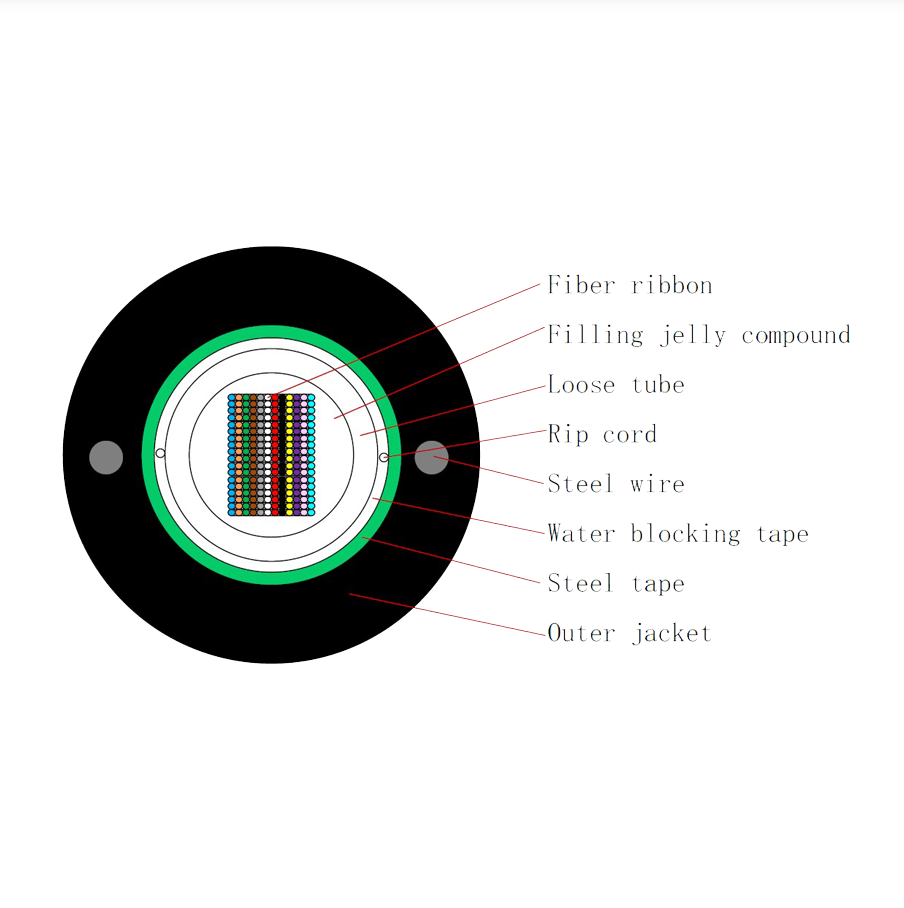
GYDXTW fiber optic cable uses a central loose tube ribbon structure for high-density outdoor duct and distribution networks. Optical fiber ribbons are stacked inside a single central loose tube, helping reduce cable diameter and improve mass-fusion splicing efficiency.
| Layer | Component | Material / Function |
|---|---|---|
| 1 | Optical Fiber Ribbon | 12-fiber ribbon matrix, G.652D / G.657A1 single-mode fiber, subject to project requirements |
| 2 | Central Loose Tube | PBT (polybutylene terephthalate) central loose tube, gel-filled, housing fiber ribbon stacks |
| 3 | Water-Blocking Elements | Water-blocking tape and filling compound preventing longitudinal moisture migration |
| 4 | Strength Member | FRP (Fiber Reinforced Plastic) or steel tape / PSP, subject to final cable design |
| 5 | Outer Sheath | Black PE (polyethylene) outer sheath with UV resistance for outdoor duct installation |
| Item | Typical Value / Option | Notes |
|---|---|---|
| Fiber type | G.652D / G.657A1 / G.657A2 | Confirmed by project specification |
| Fiber count | 48-288 fibers | Ribbon configuration subject to final design |
| Ribbon unit | 12-fiber ribbon | Designed for mass fusion splicing efficiency |
| Outer sheath | PE | For outdoor duct and conduit installation |
| Application | Metro duct / distribution / access networks | Final use depends on route design and project conditions |
High-fiber-count trunk cable for metropolitan underground conduit routes with mass fusion splicing at splice points.
Backbone distribution cable connecting central offices to FTTx access nodes in urban and suburban networks.
High-density trunk cable between data centers for reliable, high-bandwidth inter-facility connectivity.
Mass fusion splicing at splice closures enables fast deployment of long-haul and metro ribbon cable routes.
Fiber-dense cable for 5G mobile network backhaul aggregation requiring high fiber counts in limited duct space.
Compare GYDXTW with related ribbon and central loose tube cable designs before confirming project requirements.
Structure: Central loose tube ribbon fiber optic cable for compact high-density outdoor duct applications.
Typical Use: Metro access, distribution, and duct routes requiring ribbon fiber density and mass fusion splicing efficiency.
Selection Note: Choose GYDXTW when compact cable diameter, ribbon fiber density, and duct installation are the main requirements.
Structure: Stranded loose tube ribbon fiber cable with APL moisture-barrier-oriented design.
Typical Use: Outdoor duct and aerial backbone routes requiring ribbon fiber with stranded loose tube construction.
Selection Note: Use GYDTA when the project requires stranded tube layout instead of central tube design.
Structure: Central loose tube single-fiber outdoor cable with compact construction.
Typical Use: Access, distribution, and duct routes where single-fiber splicing is acceptable.
Selection Note: Choose GYXTW when ribbon fiber and mass fusion splicing are not required.
Structure: 53-type armored ribbon fiber cable for reinforced outdoor routes.
Typical Use: Direct-burial-oriented or harsh outdoor routes requiring stronger mechanical protection.
Selection Note: Choose GYDTA53 when ribbon fiber density and enhanced 53-type protection are both required.
Configure the key requirement for GYDXTW Central Loose Tube Ribbon Fiber Optic Cable. Select standard options or enter custom notes, then send your RFQ by WhatsApp or email.
Outdoor fiber cable for duct and backbone deployment.
Outdoor fiber cable for duct and backbone networks.
Central loose tube outdoor fiber optic cable.
Armored outdoor cable for direct burial installation.
Armored outdoor cable for harsh environments.
Armored central tube outdoor fiber optic cable.