Central loose tube fiber optic cable with PE outer sheath, water-blocking, and a strength-member design subject to final cable confirmation for economical outdoor duct installation, campus backbone, and aerial routes with external support.
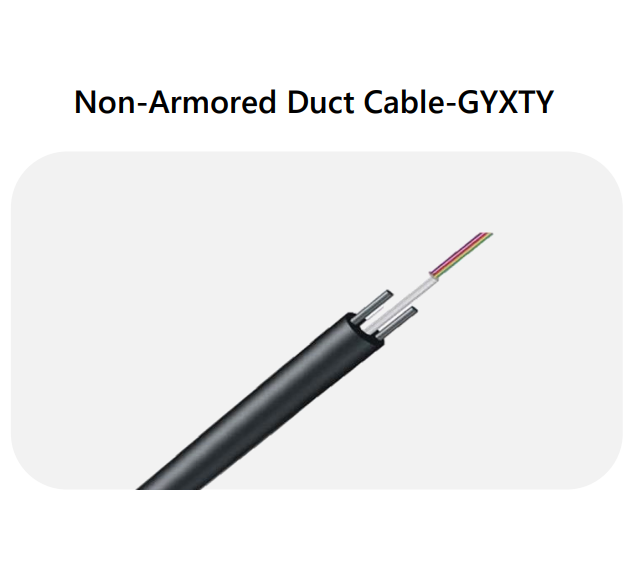
GYXTY is a central loose tube non-armored outdoor fiber optic cable with black PE outer sheath. It is designed for outdoor duct installation where economical cabling is preferred. Non-metallic strength members can be specified according to project requirements. The central tube design minimizes cable diameter and weight. Fiber count and cable dimensions depend on the project specification.
Request Quote Download DatasheetProduct Answer
What is GYXTY fiber optic cable?
GYXTY fiber optic cable is a central loose tube outdoor fiber optic cable with a PE outer sheath, designed for economical outdoor duct installation. It features a single central tube and water-blocking materials; the strength-member design is subject to final cable design. It is lighter and more flexible than armored cables, and may be used for campus backbone, access networks, and aerial routes with external support when the route design permits.
Use this guide to decide whether GYXTY is suitable for economical central loose tube outdoor routes.
| Requirement | Recommended Option | Reason |
|---|---|---|
| Economical outdoor duct route | GYXTY | Central loose tube structure with PE sheath is suitable for low-to-medium fiber count duct or access routes. |
| Direct burial or high-crush route | GYXTS / GYXTW53 | Use armored designs when stronger mechanical or underground protection is required. |
| Aerial route with external support | GYXTY with route confirmation | Use only where the route provides proper external support and span requirements are confirmed. |
| Project confirmation | Confirm fiber count, sheath, water blocking, and route | Final selection depends on route design, installation conditions, and protection level. |
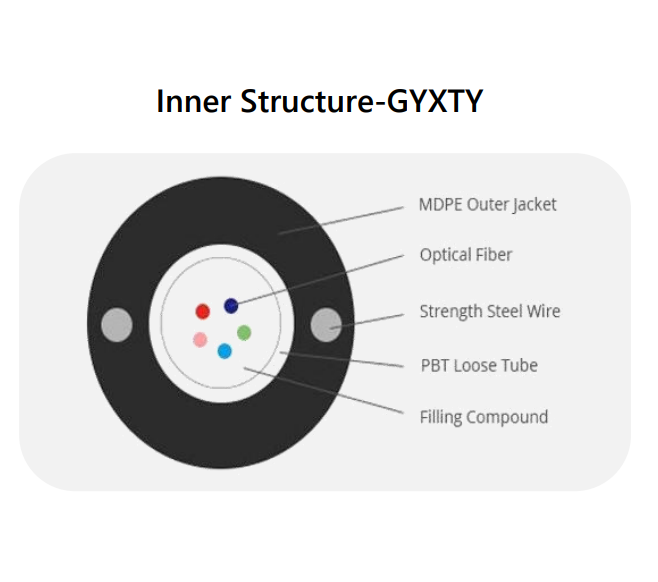
GYXTY is a central loose tube outdoor fiber optic cable with PE outer sheath and a strength-member design subject to final cable confirmation. It is suitable for economical duct, campus backbone, access network, and supported outdoor routes.
| Layer | Component | Material / Function |
|---|---|---|
| 1 | Optical fiber unit | Fibers in central loose tube according to project fiber count. |
| 2 | Water blocking | Filling compound or water-blocking elements protect the fiber unit. |
| 3 | Strength design | Strength elements and material are subject to final cable design. |
| 4 | Outer sheath | PE outer sheath provides environmental protection for outdoor routes. |
Typical values for reference. Final cable parameters depend on fiber count, central tube structure, PE sheath, strength member, and customer specification.
| Parameter | Typical Value |
|---|---|
| Attenuation @ 1310 nm | Confirm the fiber category and acceptance limit in the approved fiber and cable specification. |
| Attenuation @ 1550 nm | Confirm the fiber category and acceptance limit in the approved fiber and cable specification. |
| Operating Temperature | Confirm the required range in the approved datasheet and project specification. |
| Storage Temperature | Confirm the required range in the approved datasheet and project specification. |
| Standards | Confirm applicable standards and acceptance requirements in the project specification. |
| Compliance documentation | Confirm applicable documents and test requirements in the project specification. |
Last-mile feeder and distribution cable from cabinet to building or curb in FTTH networks.
Inter-building duct connections in campuses and industrial parks where non-armored cable is sufficient.
Outdoor duct sections of enterprise LAN connecting buildings with economical non-armored cable.
General duct cabling in telecom access and distribution networks where armored cable is not required.
Cost-effective duct cabling for FTTx and broadband network deployment in protected duct infrastructure.
Compare GYXTY with related central loose tube and armored outdoor cable designs before confirming project requirements.
Structure: Central loose tube non-armored outdoor cable with PE sheath for economical duct installation.
Typical Use: Outdoor duct, campus backbone, access network, and aerial routes with external support.
Selection Note: Choose GYXTY when lightweight non-armored central tube design is required and direct burial is not required.
Structure: Central loose tube outdoor cable with steel-polyethylene composite protection / PSP.
Typical Use: Access and distribution routes requiring stronger crush or rodent protection than GYXTY.
Selection Note: Use GYXTW when central tube design is needed with steel-polyethylene composite protection / PSP, subject to final design.
Structure: Central loose tube outdoor cable with steel tape protection.
Typical Use: Outdoor routes requiring compact structure and mechanical protection.
Selection Note: Confirm sheath and armor requirements before choosing between GYXTY, GYXTW, and GYXTS.
Structure: Non-metallic stranded loose tube outdoor cable.
Typical Use: Outdoor routes requiring non-metallic construction and higher design flexibility than central tube cable.
Selection Note: Choose GYFTY when a stranded non-metallic outdoor structure is required by the project.
Configure the key requirement for GYXTY Central Loose Tube Fiber Optic Cable. Select standard options or enter custom notes, then send your RFQ by WhatsApp or email.
For the central loose tube, steel-tape protection, and RFQ fields to confirm before production, see the GYXTW cable specification guide, which also explains when GYXTY or GYXTW53 is the better construction boundary.
Central loose tube outdoor fiber optic cable.
Central tube outdoor cable with steel strength member.
APL moisture barrier stranded loose tube outdoor cable.
Steel tape armored stranded loose tube outdoor cable.
Non-metallic loose tube outdoor cable for aerial and duct use.
All-dielectric self-supporting aerial fiber optic cable.